
eSAF. Jet fuel from waste carbon and electricity.
Made at commercial scale since 2023, and in August 2026 it flew a paying American Airlines passenger service. Not a demonstration batch — fuel out of a working plant, into a wing, on a scheduled flight.
Scroll sideways to follow the whole pathway.
Jet fuel assembled from emissions instead of extracted from crude
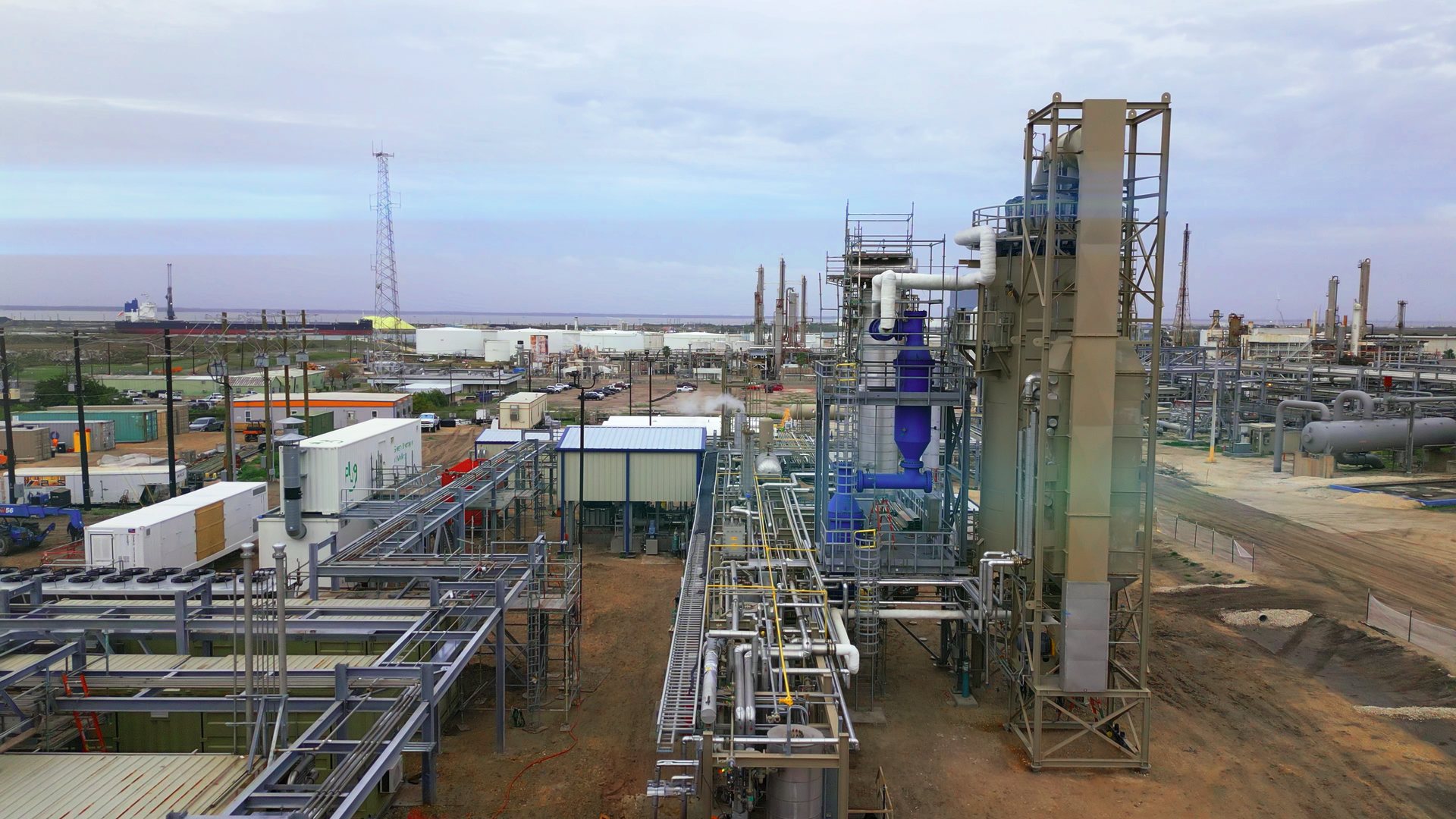
eSAF is an electrofuel: sustainable aviation fuel made by power-to-liquids. Renewable electricity splits water into hydrogen. That hydrogen combines with carbon dioxide captured from an industrial source in Infinium React™, which produces syngas. Infinium Synthesize™ then converts the syngas into finished jet fuel in a single catalytic step.
What comes out is a synthetic paraffinic kerosene — the same class of molecule that comes out of a refinery's kerosene cut, minus the sulfur and most of the aromatics. It is not a biofuel and it does not compete with agriculture for land or water. Compared with biofuel pathways it uses a small fraction of the water and a small fraction of the land per gallon, because the carbon comes from a flue stack rather than a field.
Because the fuel is chemically conventional, everything downstream of the plant gate is conventional too: the same tanks, the same pipelines, the same trucks, the same wing. No aircraft modification, no engine certification programme, no new airport infrastructure.
There is no other lever on the aircraft flying in 2040
The world burns roughly 100 billion gallons of jet fuel a year moving more than four billion passengers. Sustainable aviation fuel is still under one per cent of that. Meeting net zero commitments implies something on the order of eight million barrels a day of SAF by 2050.
Battery-electric and hydrogen aircraft do not close that gap on the relevant timescale — the energy density is not there for long-haul, and the fleet in service today will still be flying in the 2040s. Drop-in liquid fuel is the only intervention that reaches those aircraft, and eSAF is the drop-in route with the largest theoretical ceiling, because its feedstock is not a crop.
Nothing to retrofit
Meets existing aviation turbine fuel specifications and blends into the supply chain that already exists.
Cleaner combustion
No sulfur and very low aromatics, which cuts soot and particulate formation as well as CO₂.
Not land or water constrained
The carbon comes from industrial emissions, so supply does not compete with food production.
Where the ninety per cent comes from
Power-to-liquids SAF is expected to reduce lifecycle greenhouse gas emissions in aviation by around ninety per cent against conventional jet fuel — higher than the SAF pathways on the market today. Project Atlas is designed to a ninety-five per cent reduction target.
The reduction rests on two things being true at once. The carbon in the fuel was already emitted by an industrial process, so burning the fuel returns it rather than adding newly extracted carbon. And the energy that assembled the molecule was renewable, so the conversion itself does not create a new emissions burden. Take either leg away and the number collapses, which is why Infinium sites projects against concentrated CO₂ sources and contracts renewable generation purpose-built for the plant.
Carbon intensity is certified per project with the relevant accredited body, and every offtake contract references the certified figure for the specific plant supplying it rather than a platform average.
How eSAF is classified
eSAF sits squarely inside the regulatory category built for it. RefuelEU Aviation sets a synthetic aviation fuel sub-target alongside its headline SAF obligation, written specifically around fuels made from renewable hydrogen and captured carbon — which is what eSAF is. That sub-target is the reason European carriers have been contracting eSAF years ahead of delivery: the volumes are mandated and the supply is structurally short.
In the United States, eligibility under state low-carbon fuel programmes and federal SAF incentives turns on certified lifecycle carbon intensity, where the power-to-liquids pathway performs strongly. Infinium also supplies eSAF on a certificate basis for corporate travel programmes where physical delivery into a specific airport is not practical.
Compare with the feedstock-dependent position for mSAF, where classification varies by gas source.
What you are actually buying
| Product type | Synthetic paraffinic kerosene |
|---|---|
| Specification | Meets existing aviation turbine fuel specifications, within approved blend limits |
| Lifecycle GHG reduction | Around 90% against conventional jet fuel |
| Sulfur | None |
| Aromatics | 0.1–8 vol% |
| Density at 15 °C | 0.75–0.84 g/cm³ |
| Smoke point | 40–80 mm |
| Final boiling point, D86 | 235–285 °C |
| Feedstock | Waste CO₂ and renewable electricity |
Typical values from Infinium process data. Actual batch properties are confirmed on the certificate of analysis supplied with delivery.
Handling and blending
- Blends with conventional jet fuel and is handled as jet fuel from the blend point onward
- No change to fuelling equipment, filtration or aircraft systems
- Low aromatics and zero sulfur reduce soot and particulate formation on combustion
- The effect of low-soot fuels on contrail formation is an active area of research and Infinium does not claim a quantified benefit
- Delivered physically into the fuel supply chain, or as certificates where physical delivery is impractical
It has already carried passengers
In August 2026 Infinium and American Airlines announced the first delivery of eSAF to a commercial airport for use on a commercial passenger flight. The fuel was produced and blended at Pathfinder and flew a service from Corpus Christi International to Dallas Fort Worth, with Citi supporting the effort as a long-standing partner on Infinium's aviation work.
That flight matters less as a milestone than as evidence. It closed the loop from waste CO₂ at an industrial site to a fare-paying passenger, through the ordinary fuel supply chain, with no special handling.
- American Airlines — long-term take-or-pay offtake, and the first US commercial passenger flight powered by electrofuel
- IAG — ten-year purchase agreement covering British Airways, Aer Lingus and the group's other carriers
- Sustainable Aviation Buyers Alliance — Project Atlas selected as winner of the next-generation SAF procurement from more than a dozen competing projects
- Breakthrough Energy Catalyst and Brookfield — project capital committed specifically to scaling eSAF output
Where eSAF comes from
| Project | Location | eSAF capacity | Stage |
|---|---|---|---|
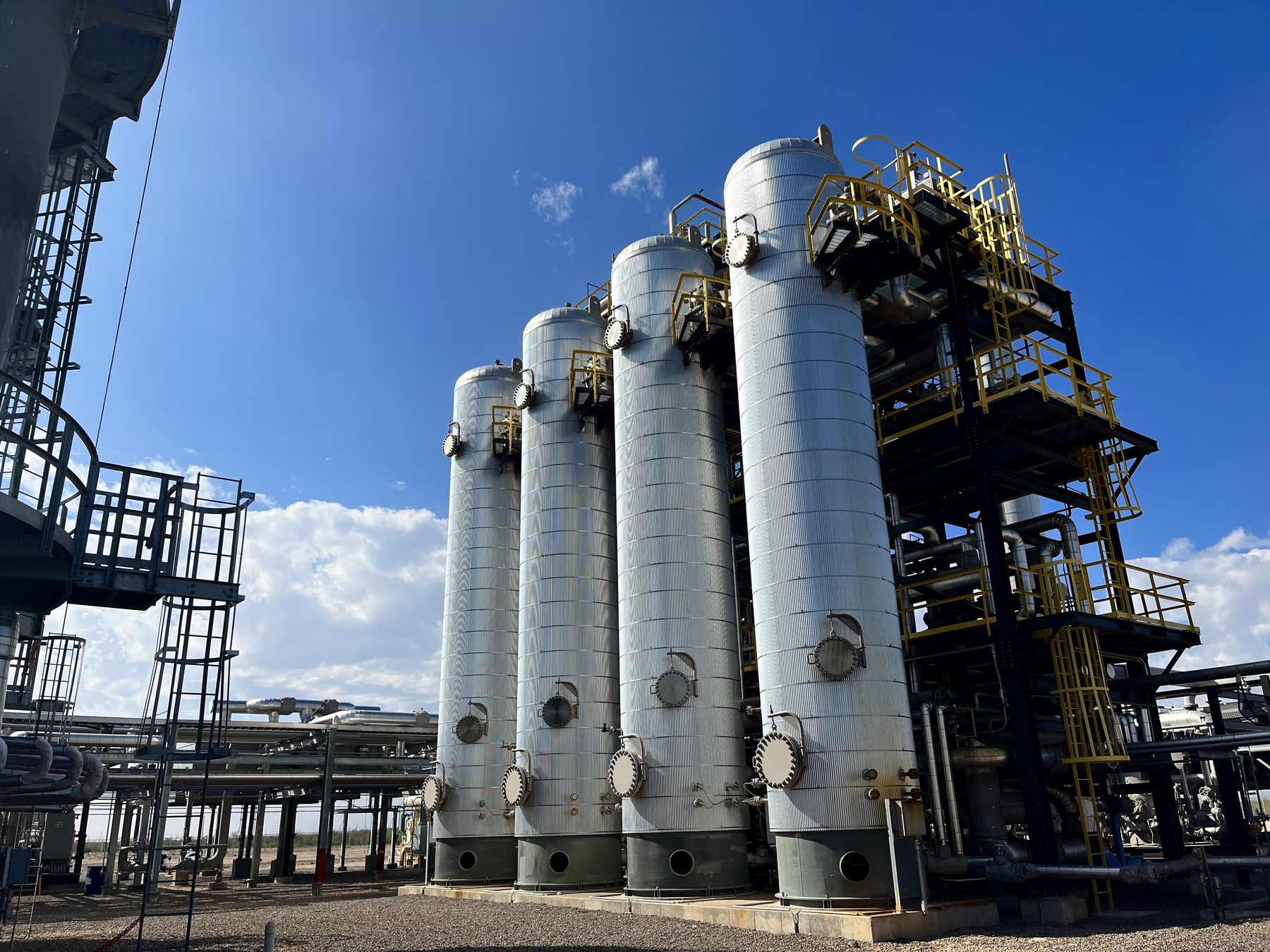
| Pathfinder | Corpus Christi, Texas | Commercial volumes alongside eDiesel and eNaphtha | Operating since 2023 |
| Roadrunner | Reeves County, Texas | 23,000 tonnes a year, about 7.6 million gallons | Under construction |
| Atlas | United States | Approximately 100,000 tonnes a year | In development, first fuel 2029 |
| Mo i Rana | Mo Industrial Park, Norway | Primarily eSAF | In development |
| eFuels SEA | Southeast Asia | eSAF and other eFuels | Licensed development platform |
How airlines and travel programmes contract it
eSAF supply is structurally short and sold well ahead of production, because long-term contracts are what make new plants financeable. Infinium's offtake agreements are take-or-pay for exactly that reason.
Long-term physical offtake
Multi-year take-or-pay volumes delivered into a named airport or fuel hub. The structure that unlocked Roadrunner and Atlas.
Certificate supply
For corporate travel programmes and carriers who need the emissions reduction without physical delivery into a specific location.
Compliance-linked volumes
Structured against a specific obligation, with the certified carbon intensity of the supplying plant stated in the contract.
And where gas is the feedstock, there is mSAF
eSAF needs a concentrated CO₂ source and abundant renewable power. Where a site has methane instead — pipeline gas, flare gas, RNG — the same Synthesize™ catalyst makes the same kerosene by a different front end.
- Both routes finish in the same reactor with the same catalyst
- Both produce synthetic paraffinic kerosene to the same specification
- A portfolio with both can be sited in far more places than one with either